
Granite has remained one of the most trusted natural stone materials in residential remodeling for decades. While homeowners often focus on color and veining, another characteristic plays an equally important role in both performance and appearance: granite texture. The finish applied to a granite slab influences how it reflects light, how easily it is cleaned, how much traction it provides, and where it performs best.
Today’s fabricators offer several distinct granite textures, each engineered to achieve a different balance of aesthetics and functionality. From highly polished kitchen countertops to textured outdoor surfaces, selecting the appropriate finish can significantly affect both everyday usability and long-term maintenance.
Understanding granito textura requires looking beyond appearance alone. By comparing common finishes and their practical characteristics, homeowners can make more informed decisions based on how the surface will actually be used.
Understanding Granite Textures
Granite finishes are created through different fabrication techniques that alter the surface while preserving the stone’s inherent strength. Each finish offers distinct visual and functional characteristics suited to specific applications.
| Finish | Appearance | Best Uses | Maintenance |
|---|---|---|---|
| Polished | High-gloss reflective finish | Kitchen countertops | Low |
| Honed | Smooth matte surface | Bathrooms, vanities | Moderate |
| Leathered | Soft textured finish | Indoor & outdoor kitchens | Low |
| Flamed | Rough textured surface | Patios, walkways, exterior spaces | Low |
| Brushed | Lightly textured satin finish | Accent surfaces and decorative applications | Moderate |
Each finish begins with the same durable natural stone. The difference lies in the way the surface is processed after fabrication.
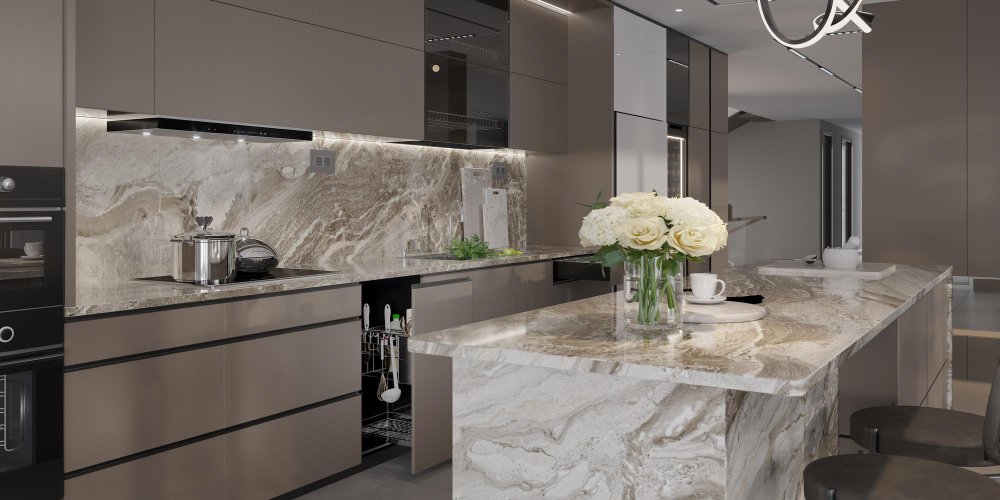
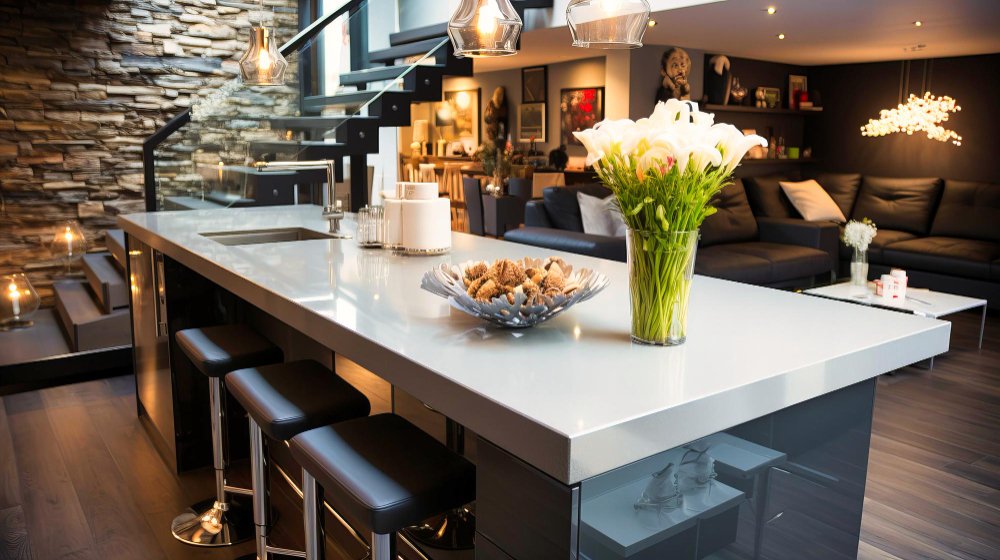
Polished granite remains the most recognizable finish. Mechanical polishing creates a glossy surface that enhances color, highlights natural veining, and reflects light throughout the room. Because the surface is smooth, routine cleaning is generally straightforward.
Honed granite removes much of that reflectivity, replacing it with a soft matte appearance. Many homeowners appreciate its understated elegance, particularly in contemporary bathrooms or minimalist kitchens. The lower sheen can make everyday wear less noticeable, although honed finishes may require slightly more attention to maintain a uniform appearance.
Leathered granite has grown considerably in popularity over the past decade. Specialized brushes create a subtle texture that follows the stone’s natural mineral structure, producing a tactile finish that reduces glare while emphasizing the granite’s organic character. It has become especially popular in outdoor kitchens and modern interior designs.
Flamed granite undergoes intense heat treatment that creates a rough, highly textured surface. Because of its excellent traction, it is frequently selected for exterior environments where slip resistance is particularly important.
Brushed granite occupies a middle ground between honed and leathered finishes. The surface retains a gentle texture while maintaining a refined appearance suitable for decorative architectural features.
Granite is one of the hardest natural stones commonly used in residential construction, making it highly resistant to everyday wear when properly fabricated, installed, sealed, and maintained.
Although these finishes create noticeably different visual effects, they all preserve granite’s fundamental strengths: impressive durability, excellent heat resistance, and long service life. The finish primarily influences maintenance, texture, light reflection, and the environments where the stone performs best rather than significantly changing its underlying structural properties.
Performance Comparison by Application
While every granite finish begins with the same exceptionally durable natural stone, each texture performs differently depending on where it is installed. Factors such as moisture exposure, direct sunlight, cleaning frequency, and foot traffic all influence which finish is most appropriate for a specific application.
In kitchens, polished granite continues to be one of the most common choices because its smooth surface is easy to wipe clean and highlights the natural color variations of the stone. Leathered granite has also become increasingly popular, particularly in contemporary kitchens where homeowners prefer a softer, less reflective appearance.
Bathrooms often benefit from honed or leathered finishes because they reduce glare while creating a calm, sophisticated aesthetic. Outdoor kitchens, patios, and entertainment areas frequently incorporate leathered or flamed granite due to their textured surfaces and strong resistance to changing weather conditions.
| Performance Feature | Polished | Honed | Leathered | Flamed |
|---|---|---|---|---|
| Scratch Resistance | Excellent | Excellent | Excellent | Excellent |
| Slip Resistance | Moderate | Good | Very Good | Excellent |
| UV Resistance | Excellent | Excellent | Excellent | Excellent |
| Cleaning Ease | Excellent | Good | Good | Moderate |
Performance Highlights
- • Granite provides outstanding heat resistance for kitchens and outdoor cooking areas.
- • Proper sealing helps improve stain resistance regardless of the finish selected.
- • Textured finishes typically make fingerprints, water spots, and smudges less noticeable than polished surfaces.
Choosing the Right Granite Texture
Selecting the best granite finish depends on how the surface will be used rather than on appearance alone. A busy family kitchen, for example, has different performance requirements than an outdoor patio or a decorative fireplace surround.
Homeowners who appreciate a bright, reflective appearance often prefer polished granite because it enhances the stone’s natural color variation while reflecting surrounding light. Those seeking a softer, more contemporary aesthetic frequently gravitate toward honed or leathered finishes, which reduce glare and create a more understated look.
Maintenance expectations should also influence the decision. While all granite finishes benefit from routine cleaning and periodic sealing, textured finishes can help disguise everyday fingerprints, dust, and water marks between cleanings.
Professional fabrication remains equally important. Precise edge finishing, accurate installation, and proper sealing contribute significantly to the long-term performance of every granite countertop regardless of its texture.
The finish does not significantly change granite’s inherent strength, but it can influence maintenance requirements, visual appearance, light reflection, and slip resistance depending on where the stone is installed.
What the Data Suggests
Looking across the most common residential and commercial applications, one conclusion becomes clear: there is no universally “best” granite texture. Instead, each finish excels under different conditions.
Polished granite continues to dominate traditional kitchen installations because of its timeless appearance and ease of cleaning. Leathered finishes have experienced growing popularity among homeowners seeking natural texture with reduced glare, particularly in modern kitchens and outdoor living spaces. Flamed granite remains a preferred solution for exterior environments where additional traction is beneficial.
Rather than selecting a finish based solely on appearance, homeowners should evaluate how lighting, maintenance expectations, daily use, and overall design goals influence long-term satisfaction.
Key Takeaways
- • Polished granite remains one of the most popular choices for residential kitchen countertops.
- • Leathered granite continues to gain popularity in contemporary indoor and outdoor designs.
- • Flamed granite is commonly selected for exterior applications where improved traction is desirable.
- • Matching the granite texture to the intended application generally produces better long-term performance than selecting a finish based on appearance alone.
Understanding granito textura allows homeowners, designers, and fabricators to make informed decisions based on measurable performance characteristics as well as aesthetics. By balancing durability, maintenance, lighting conditions, and intended use, it becomes much easier to choose a granite finish that will continue performing beautifully for many years.